

Custom Removable Gooseneck Trailers: RGNs Engineered to Your Equipment
The machine decides how it has to be hauled. A dozer that can’t safely climb steep ramps, an excavator that ends up too tall once it sits on a flatbed, a skid-mounted power package that has to ride low and stay put: each one turns a routine move into a loading risk, a permit problem or a day of downtime. A removable gooseneck trailer is designed to solve this by letting the machine drive on at ground level and ride with its weight close to the road. TarasPort Trailers engineers each RGN around the specific equipment it will carry, working out the deck length, axle configuration and neck setup for that load instead of picking them from a fixed model list.
Every TarasPort RGN is all-steel, open-deck construction, made at the company’s plant in Sweetwater, Tennessee, where it has built trailers since 1988.
What a Removable Gooseneck Trailer Does
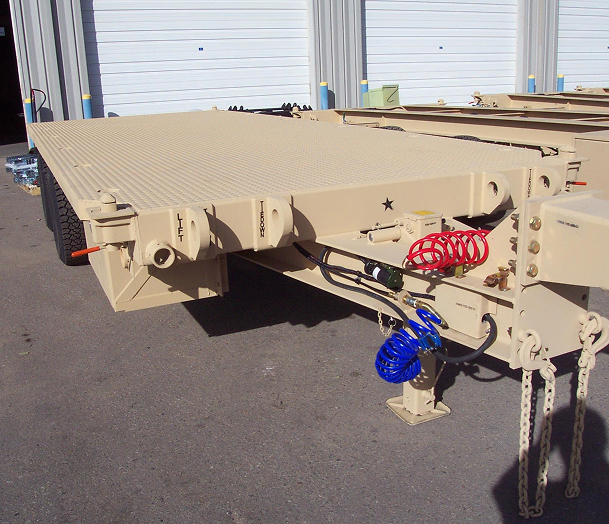
An RGN trailer, also called a detachable gooseneck trailer, is a low deck trailer whose front neck section comes off the deck. With the neck removed, the front of the deck drops to the ground and becomes the loading edge. Equipment drives or winches straight on over the front, the neck goes back on, and the deck rises to travel height with the load sitting low between the neck and the rear axles.
Front loading is what sets a removable gooseneck apart from a flatbed or stepdeck. Those trailers load from the rear, up ramps, onto a deck that rides higher off the road. That works for light, wheeled machines. For a tracked machine with a high center of gravity, or anything tall enough that deck height decides whether it clears an overpass, the ramp climb and the extra inches are the problem. For the wider background on neck styles and hitching, see TarasPort’s guide to what a gooseneck trailer is.

Front Loading and Low Deck Height for Heavy Equipment Hauling
The case for an RGN comes down to two things: how the machine gets on, and how high it rides once it’s there. With ground-level front loading, tracked and wheeled equipment can board without staging ramps or looking for a loading dock at a remote site. The approach is flatter, so the machine is less likely to shift or slip as it moves from ground to deck.
The low deck matters just as much. Because the load rides close to the road, a tall machine can stay within clearance limits without removing a cab, boom or attachment before it leaves. That saves time at both ends of the haul, and on the job site time is the cost everyone is watching. For fleets that move construction, energy and industrial equipment between sites on a regular schedule, the minutes saved at each end add up over a year of moves.
Deck Length, Axle Configuration and Neck Setup Engineered to Your Equipment
Deck Length
Deck length starts with the machine’s footprint: its track length or wheelbase, how far booms or blades overhang, and where its center of gravity sits. The well is sized to the heaviest machine the fleet moves, with room for attachments that travel alongside it. A standard deck length can leave a load sitting too far forward or too far back, and that shows up in the axle weights.
Axle Configuration and Suspension
Axle count, spacing and suspension are chosen for the gross weight and for the routes the trailer will run. A trailer that spends most of its miles on highways is set up differently from one that regularly works rough site access roads or oilfield leases.
Neck Setup
The neck setup is engineered to the job, not sold as one fixed spec. How often the neck will come off, the ground it will come off on, and the tractor it couples to all shape the design.
Flooring
Reinforced flooring goes where track pads, outriggers or skid rails put concentrated load. Tie-down points are placed to line up with the machine’s actual securement points, so crews aren’t making do with whatever anchor happens to be closest. TarasPort’s page on custom trailers for equipment mobilization explains how the same process works for full fleet mobilization programs.
All-Steel, Open-Deck Construction at the TarasPort Plant
TarasPort’s RGN trailers use steel, open-deck construction. Steel suits a trailer that goes through repeated loading cycles: tracks turning at the loading edge, point loads under outriggers, and a frame flexing under a concentrated load on uneven ground. The open deck keeps the full deck available for machines that overhang and keeps every tie-down point within reach.
As a removable gooseneck trailer manufacturer, TarasPort builds these trailers at one plant on Industrial Park Road in Sweetwater, Tennessee. That plant is behind more than 37 years of building, more than 4,000 trailers and more than 1,000 clients in 30+ states, with finished trailers delivered across the continental United States. TarasPort designs its trailers to stay in service long after the build.
Weight Distribution and DOT Standards
An RGN’s capacity comes out of its build, which is why TarasPort engineers it for each trailer rather than quoting one figure that would mislead. What a removable gooseneck can carry depends on the axle ratings, the number and spacing of the axles, the suspension, and how the machine’s weight splits between the neck, the deck and the rear axle group. A machine that carries its weight toward the front loads the tractor differently from one that sits balanced over the well.
So capacity is engineered to the job. The starting inputs are the operating weight of the heaviest machine, its dimensions and where its weight sits. The axle configuration is then specified so that the loaded combination keeps each axle within its rating. Every TarasPort trailer is designed to meet DOT standards.
The route matters as much as the weight. On interstates, the federal bridge formula limits how weight can be spread across axle groups, and each state sets its own oversize and overweight permit rules. TarasPort brings these limits into the engineering at the start. A trailer whose axle spacing forces a permit on every trip loses uptime on every move.
Who Runs a Custom RGN: Construction, Energy, Defense and Owner/Operators
Construction fleets use RGNs to move excavators, dozers and cranes between job sites, where front loading means crews spend less time preparing the ground before a machine can board. In the energy and industrial sectors, the same platform carries oilfield equipment and skid-mounted power packages that have to ride low and stay tightly secured over long distances. Defense buyers need a trailer that is ready whenever the equipment has to move, which puts the weight on durability and on a spec that matches the equipment exactly. Owner/operators who haul the same kinds of loads over the same routes get the most from a trailer built for those roads and those machines, because a trailer out of service means no revenue.
Not every load needs a detachable neck. If a machine can be loaded without front access, a fixed-neck heavy-duty lowboy trailer or a rear-loading equipment trailer may do the job with fewer moving parts.
How a TarasPort RGN Build Is Quoted
Every TarasPort RGN starts with your equipment list and how the trailer will be used: what it carries, how often, over which roads and behind which tractor. TarasPort’s engineers turn that into a specification, and the quote is written against it, which is why each trailer is priced and built to order.
Pricing is meant to be competitive for the capability the job actually needs. Sizing the axles and deck to your real heaviest load means you don’t pay for capacity you will never use, while still leaving margin where the load calls for it. Financing is available through several outside sources; contact TarasPort for details. If you’re comparing an RGN with other platforms, see the full TarasPort trailer lineup.
The Sweetwater plant takes calls at (423) 337-4660, Monday to Friday, 7 a.m. to 5 p.m. The first conversation goes further if you have the machine’s operating weight, dimensions and securement points ready.
RGN Questions Fleet and Equipment Buyers Ask Gooseneck Trailer Manufacturers
Request a quote for a custom RGN trailer from TarasPort Trailers, manufactured in Sweetwater, Tennessee and serving customers throughout the continental United States.
What is the maximum capacity of a removable gooseneck trailer?
No one maximum applies to every RGN. Capacity comes from each trailer’s axle ratings, axle count and spacing, and how the load spreads across the deck, and all of these change from build to build. If a trailer you did not spec comes with a single capacity number, treat it as the start of your questions, not the answer. For a TarasPort RGN, bring the operating weight of your heaviest machine plus everything that travels with it, such as buckets, blades, or counterweights. TarasPort sizes the axle configuration to that full load and to where it sits on the deck.
Do I need a CDL to pull a 40 ft gooseneck trailer?
Often, yes, in commercial equipment work, but the 40-foot length is not what triggers it. The license depends on weight ratings, so check the ratings on the truck and trailer before you assign a driver, not the deck length. Contact your state’s Department of Transportation or licensing agency to confirm CDL requirements, as they vary by your state’s regulations, equipment specifications, and your vehicle’s gross combination weight rating.
What is the longest gooseneck trailer you can pull without a CDL?
No length sets the line. Because CDL classes follow weight ratings, a short trailer with a heavy rating can require a Class A while a longer, lightly rated one may not, so the rating plate on the trailer tells you more than a tape measure. Length does matter in other ways: states limit overall vehicle and combination length on their roads, and several states have their own license rules for heavy non-commercial combinations. Check with the state where the rig is registered and driven.
Can I pull a 14000 lb trailer without a CDL?
Only if the whole combination stays under a 26,001-pound gross combination weight rating. A trailer rated at 14,000 pounds is already over the 10,000-pound towed-unit line for a Class A. Put another way, the truck now decides the answer. Add the truck’s rating to the trailer’s 14,000 pounds, or use the truck maker’s stated combination rating if that is higher. If the result reaches 26,001, a driver in commercial service needs a Class A. The ratings count even when the trailer runs empty, and some states set stricter rules for non-commercial towing, so confirm your combination with the state licensing agency.
What tows more, a 5th wheel or a gooseneck?
For a heavy-haul RGN the question mostly disappears. The removable gooseneck on these trailers usually couples to a tractor’s fifth wheel, so “gooseneck” describes the shape of the neck, not a ball hitch. The numbers to compare are the tractor, its fifth-wheel rating and the trailer’s axle configuration, not one hitch style against the other.
Capacities, dimensions and configurations are engineered for each build and depend on axle ratings, load distribution and the state and federal rules that apply. Licensing information here is general guidance; confirm requirements with your state licensing agency.