What Are Stepdeck Trailers?
Certain cargo simply refuses to behave like standard freight. It rises too high, shifts too easily, or exceeds safe road clearance when placed on a flat platform. That’s where stepped trailer design becomes a practical engineering answer rather than a variation of a flatbed.
Features and Customization Options for Stepdeck Trailers
A stepped configuration opens up engineering decisions that don’t exist in traditional trailer layouts. Because of that, every design becomes a balance between height control, weight flow, and structural strength.
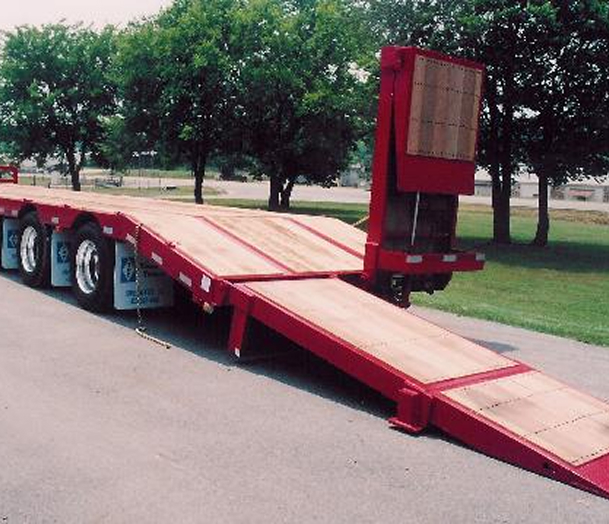
We develop stepdeck trailers with an emphasis on how the structure performs under motion, braking, and uneven terrain. Because a stepped configuration introduces engineering decisions that don’t exist in traditional flat layouts, every build becomes a specific response to the load it will carry — its height, shape, entry angle, and how stress travels through the frame during real hauling.
Instead of treating each trailer as a fixed product, we treat it as a transport system shaped around a specific movement problem. Load transition zones, axle placement, and deck geometry are adjusted based on how stress travels through the frame during real operation, not just static weight.

Common Uses and Benefits of Stepdeck Trailers
Transport challenges often begin the moment equipment exceeds standard height limits. Once that happens, routing restrictions, safety constraints, and handling difficulties become part of every trip.
Moving tall
Construction machinery between job sites
Transporting
Agricultural equipment with elevated frames
Handling
Industrial fabrication units and oversized assemblies
Supporting
infrastructure and energy sector logistics
Relocating
Manufacturing equipment across facilities
Shipping cargo
That cannot remain within standard height clearance
Managing
Multi-stop freight distribution involving mixed load sizes
A lower deck position naturally shifts the center of gravity downward. That change improves road stability, especially during highway travel or when dealing with wind exposure. The result is more controlled handling even when carrying complex loads.
Another advantage comes from reduced loading friction. Equipment can be positioned with less vertical lift, which simplifies crane operations and improves workflow efficiency on busy sites.
Durability plays a long-term role as well. Constant loading cycles, vibration exposure, and heavy industrial use demand structural resilience rather than standard reinforcement. The stepped design is engineered to handle that repeated stress without structural fatigue building quickly.
Why Choose TarasPort Trailers?
We approach trailer manufacturing as an engineering response to real transport problems rather than a catalog-driven process.
TarasPort Trailers produces stepdeck trailers in the USA with a focus on structural precision, long-term durability, and application-specific design. Each build starts with understanding how the trailer will actually be used in motion, not just what it needs to carry on paper.
Instead of standardizing output, we shape each project around functional requirements that come directly from field operations.
We don’t force equipment into preset designs. The design evolves around the equipment itself, which changes the outcome entirely. Our builds reflect direct collaboration throughout the process, with fabrication standards built for industrial pressure environments and experience across construction, energy, agriculture, and logistics sectors.
That is why many customers return when their transport needs expand or shift. The equipment continues to perform because it was never built as a generic solution in the first place.
FAQ’s
Frequently asked questions
Please tell us what you need. Our team is ready and happy to help.